
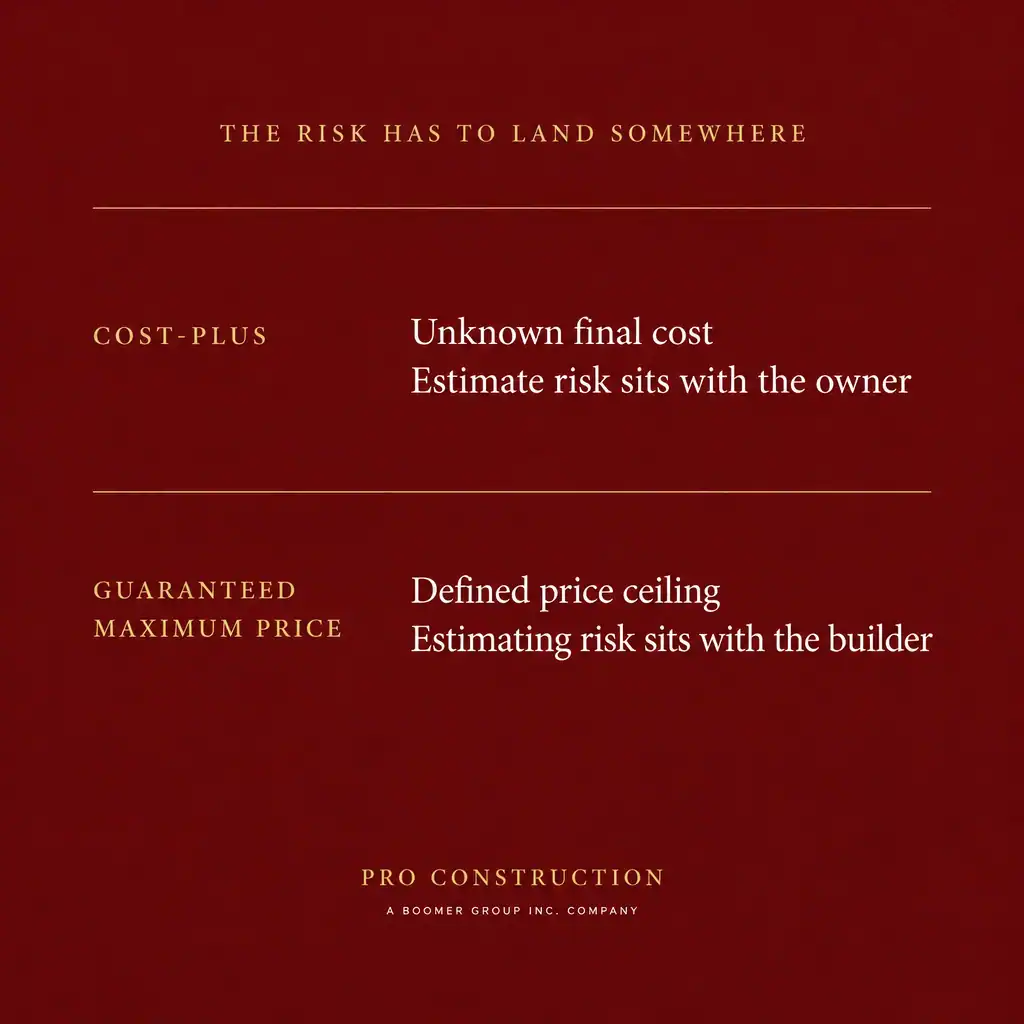
When you commit to a construction project, do you know where the estimating risk lands if the final trade bids come in higher than expected? The answer is usually in the contract structure, not in the builder’s reassuring description of how the project will go.
Cost-plus and Guaranteed Maximum Price (GMP) contracts assign that risk differently. Cost-plus can be workable when a project’s scope is still developing, but it does not, by itself, establish a final price ceiling. A carefully defined GMP does set a contractual ceiling for included work, subject to the agreement’s assumptions, exclusions, and change-order process.
The two structures side by side
With cost-plus, you pay the project’s actual costs, such as trade work and materials, plus the builder’s agreed fee. Your final total is determined as the project proceeds and costs are recorded. Unless the agreement establishes a separate ceiling, the final number arrives at the end.
A Guaranteed Maximum Price is a contractual ceiling for a defined scope of work, subject to the agreement’s terms. It sets out what the builder is responsible for delivering and how specified exceptions, changes, and allowances are handled.
The label alone does not tell you enough. Read the scope, assumptions, exclusions, allowance schedule, and change-order terms alongside the headline contract type. A GMP with broad exclusions may leave meaningful costs outside its ceiling. A cost-plus agreement with strong cost controls may provide useful visibility, but still may not give you a defined maximum.
Why cost-plus exists at all
There are legitimate reasons a builder may use cost-plus. If the design is incomplete, selections are undecided, or the site presents unresolved questions, a builder may not be able to responsibly price the entire project as a defined scope yet.
But there is another reason the structure can be appealing to a builder: it can be used when that builder does not have the depth of local pricing history or repeat trade relationships needed to estimate with confidence. A builder may collect bids from individual trades before construction, add an agreed fee, and oversee the work. That may be transparent about costs, but it is still a pass-through, not a price ceiling. The homeowner pays the trade costs as they occur, plus the builder’s fee, and carries the risk if the original estimate was low.
That distinction matters. If a builder has limited experience with a particular type of work in North Texas, an estimate may not fully account for local labor availability, site conditions, or the sequencing required. Under cost-plus, a missed estimate generally becomes the owner’s added cost, not the builder’s.
The incentive reversal
Under cost-plus, the builder’s fee may increase as project costs rise if the fee is calculated as a percentage of those costs. That arrangement can point in the opposite direction from the homeowner’s interest in controlling the total.
A fixed fee or other cost-control provisions can change the incentives, so ask how the fee is calculated and whether it changes when costs change. Also ask how trade bids are reviewed, how savings are treated, and whether you can see supporting invoices.
Under a GMP, the builder has a direct reason to estimate the defined work carefully and manage it well: in-scope overruns may reduce the builder’s return, while favorable pricing can benefit the builder under the agreement’s savings provisions. The contract should say clearly who receives savings and who is responsible for overruns.
An unknown final cost is not a price ceiling
“We’ll see what it comes to” may be a candid description of cost-plus, but it is not a number you can plan around. You still need to decide whether the project fits your finances, coordinate financing, and consider how construction spending affects the rest of your household plans.
An estimate or working budget can help with early planning, but neither necessarily caps what you owe. Ask what happens if trade bids exceed the estimate, if materials change in price, or if a project assumption proves wrong. If the answer is that actual costs are passed through, understand that before signing.
For a home addition or a detached garage or workshop, design details and selections can affect the scope substantially. The more those details are defined before construction, the more meaningful a contract ceiling can be.
Scope creep becomes frictionless
When costs are passed through, it can be easy for small decisions to feel as if they have no immediate price consequence. A selection changes, a detail is added, or a field adjustment seems minor. Over time, those choices can add work and expense, even when no one intended the project to grow.
That does not mean cost-plus automatically causes scope creep. It means the contract needs a disciplined change process. Before approving a change, ask for its written description, cost impact, schedule impact, and any adjustment to the GMP or project budget. Confirm who must approve it and how approval is documented.
An electronic client portal can make it easier to keep selections, change orders, invoices, scheduling, and messages organized in one place. The system is useful, but the signed agreement should still establish what counts as approval.
Waste and scheduling risk: who absorbs it?
Construction involves coordination among trades, deliveries, inspections, and site conditions. Ask how the contract treats a missed delivery, re-work, a trade that does not arrive as scheduled, or a weather delay.
Under cost-plus, the owner may carry more of the financial effect if the related costs are reimbursable. Under a GMP, the builder generally carries the estimating risk for work included in the defined scope, but the agreement determines how delays, excusable events, and excluded conditions are handled. Do not assume that every schedule disruption or added cost automatically falls on one party.
The point is to make responsibility clear before work begins. A written process protects the working relationship as well as your budget.
What has to be true to offer a GMP honestly
A reliable GMP starts before the first day of construction. The scope needs to be documented. Key selections should be defined as far as practical. Allowances should be limited, clearly described, and explained. The builder also needs enough local experience and a dependable trade base to recognize when a bid is incomplete or out of line.
That takes more than collecting proposals. It takes knowing how the trades’ work fits together, what assumptions a bid depends on, and where a gap could turn into a dispute later.

Note: This image was created with AI assistance.
For a homeowner, the practical test is whether the builder can explain the estimate, identify what is excluded, and show how changes will be managed, not simply present a ceiling and ask you to trust the label.
What GMP does not mean
A GMP is a ceiling for a defined scope, not a promise that every unknown condition or owner-requested change is included. The contract should state how concealed conditions, allowances, and changes are handled.
For example, an allowance is an estimated amount for a selection or work item that has not been fully specified. If the final selection or actual work exceeds that allowance, the owner may owe the difference under the contract. Concealed conditions, such as an unexpected issue uncovered during demolition, may also be treated separately.
Procore’s overview of GMP contracts describes the importance of defining how changes and unforeseen conditions affect the agreement. For your project, have the builder explain those terms in plain language and identify the documents that control.
Questions to ask before signing either structure
Use these questions to compare proposals on the same basis:
- What exact plans, specifications, and selections define the scope?
- Which work, materials, or services are excluded?
- How is the builder’s fee calculated, and can it change?
- Which allowances remain, and what happens if an allowance is exceeded or unused?
- How are concealed conditions documented, priced, and approved?
- Does any change require written owner approval before the work proceeds?
- How are savings, re-work, missed deliveries, and schedule disruptions handled?
- What invoices, bids, and cost records can the owner review?
- If the contract is a GMP, what specifically can change the ceiling?
A builder should welcome these questions. Clear answers help you understand what you are agreeing to and reduce the chance that a difficult conversation comes later.
A clearer path for North Texas homeowners
At PRO Construction | A BOOMER GROUP INC. COMPANY, we use a Guaranteed Maximum Price on every project. We believe that structure supports a clear conversation about scope, estimating, and responsibility before construction begins. It does not make every unknown disappear; it puts the agreement and its exceptions where both sides can review them.
Bruce Laing brings more than 25 years of local North Texas experience, and our team has more than 60 years of combined experience across builders, project managers, and interior designers. Each project includes a dedicated project manager and interior designer. We coordinate design, permitting, and construction as a connected service, and use an electronic client portal to organize selections, scheduling, change orders, invoices, and messages. Flexible financing options are also available.
Our work serves homeowners in Keller, Southlake, Colleyville, Fort Worth, North Richland Hills, and surrounding DFW communities. We value local working relationships with Gus Moreland at First United Bank, Builders FirstSource, ProSource, and Sherwin-Williams.
If you are weighing a project such as a home addition, ask us to walk through the scope and explain how the contract assigns risk. Honest, steady work starts with clear terms.
Let’s talk
Start a conversation with PRO Construction about your project and the contract structure behind it.
PRO Construction | A BOOMER GROUP INC. COMPANY
Phone: 817-372-0211
Email: info@proconstructiontx.com
Website: www.proconstructiontx.com
Leave a Reply